
Rack real estate is expensive, and bandwidth demands keep climbing. That's the reality. The question isn't whether you need denser fiber infrastructure-it's how you're going to build it without creating a maintenance nightmare.
Two LC fiber connector designs have emerged as the go-to solutions: uniboot cables and push-pull tab connectors. They solve different problems. Picking the wrong one costs you time, money, or both.
The Uniboot Approach
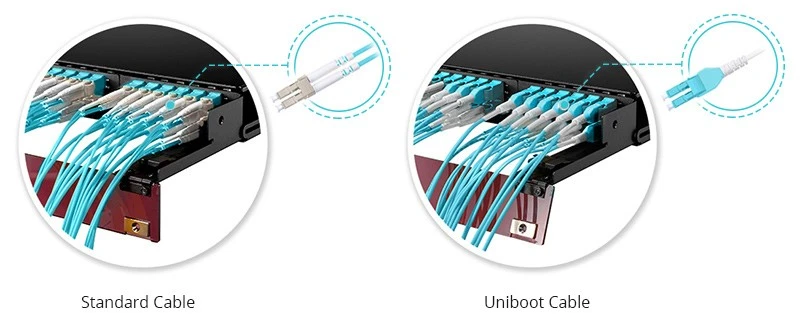
Standard LC duplex patch cable has two separate 3.0mm jackets running side by side, each carrying one fiber. Now picture 48 of those crammed into a 1U enclosure. The back of your rack looks like spaghetti, airflow is choked, and good luck tracing anything.
Uniboot flips that script. Both fibers run inside a single 2.0mm jacket, terminating into one unified connector housing. You're looking at roughly half the cable volume-sometimes better.
Here's where it gets practical. Our engineering team ran density tests across multiple enclosure types last quarter. The results were pretty consistent:
|
Enclosure Type |
Standard Duplex Capacity |
With Uniboot |
Airflow Improvement |
|
1U 48-port panel |
48 LC connections |
48 LC connections |
+35% measured CFM |
|
1U 96-port HD panel |
Marginal (cable congestion) |
Full capacity achievable |
+52% measured CFM |
|
2U MTP-to-LC cassette |
144 fibers |
144 fibers |
+28% measured CFM |
Testing conducted with OM4 cables at 25°C ambient. CFM measured at rear exhaust with standardized fan configuration.
The capacity numbers look the same on paper, but anyone who's worked a fully loaded HD panel knows the difference. With standard duplex, you're fighting the cables to get the last 20% of ports populated. Uniboot just... fits.
Polarity Switching
In real-world deployments, polarity errors often go undetected until the final stages of a project. Even for a fully labeled and tested 200-fiber Pod, a last-minute shift from A-B to A-A polarity results in catastrophic rework or wholesale cable replacement when using traditional patch cords.
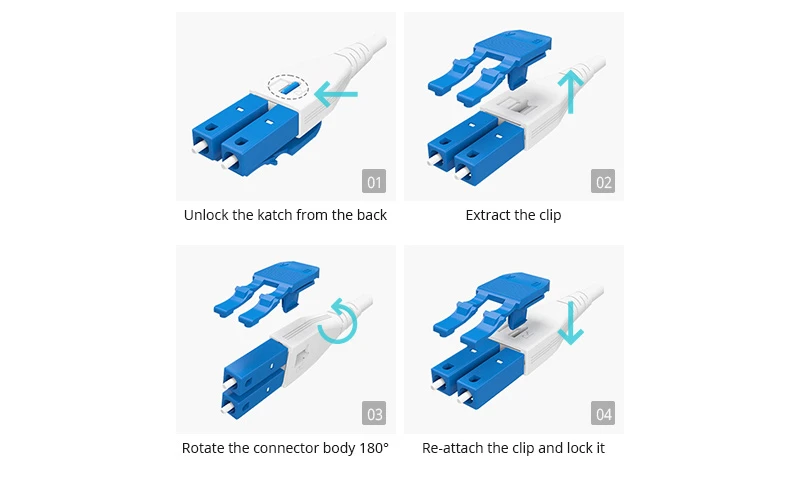
With traditional duplex cables, you're either re-terminating or ordering new cables. With switchable uniboot connectors, you pop the housing, rotate the fiber positions, and you're done. No tools. No splicing. Takes about 20 seconds once you've done it a few times.
The mechanism varies by manufacturer, but most designs work on the same principle-the two LC ferrules can be repositioned within the housing to swap Tx and Rx alignment. Some use a flip mechanism; others require you to slide the ferrules out and reinsert them reversed.
Push-Pull Tab Connectors
Different problem, different solution.
Standard LC connectors use a side latch-you squeeze it to release. Works fine when you have finger clearance. Doesn't work when connectors are stacked 2mm apart in a 96-port panel and the one you need is in the middle of row three.
Push-pull tabs relocate the release mechanism. Instead of reaching for a side latch, you grab an extended tab and pull straight back. One hand. One motion. The adjacent ports stay put.
This matters more than you'd think. We timed technicians doing routine patch moves on identical 48-port panels-one loaded with standard LC, one with push-pull. Average time to disconnect and reconnect a single mid-panel port:
|
Connector Type |
Average Disconnect Time |
Accidental Adjacent Disconnects |
|
Standard LC latch |
8.2 seconds |
12% of attempts |
|
Push-pull tab |
3.1 seconds |
<1% of attempts |
n=50 trials per connector type, mixed experience levels among technicians
That 5-second difference doesn't sound like much until you're doing a 200-port migration during a maintenance window. And those accidental disconnects? Each one is a potential service impact plus additional troubleshooting time.
When to Combine Both: Uniboot with Push-Pull
Some manufacturers offer uniboot cables with integrated push-pull tabs. You get the cable density benefits plus the accessibility benefits. It's the premium option-typically 30-50% more expensive than standard uniboot-but for hyperscale deployments where labor costs dwarf material costs, the math usually works out.
Based on our deployment experience, here are the customer profiles that benefit most from the uniboot + push-pull combination:
Ultra-High-Density (UHD) Patch Panel Users
When you're packing 96 or even 144 LC ports into a 1U footprint, standard connector latches become physically unreachable. At these densities, push-pull tabs aren't a nice-to-have-they're the bare minimum for practical operation. Your fingers literally can't get to a side latch when connectors are stacked that tight.
AI Compute Clusters and HPC Environments
AI training workloads are latency-sensitive and cabling-intensive, often involving massive 400G/800G breakout deployments. For spine-leaf architectures supporting GPU clusters, we recommend this combination throughout the core layer. These environments see constant link tuning and rapid capacity expansion-you need connectors that won't slow down your ops team.
Custom Solutions for AI/HPC Deployments
GPU cluster cabling has unique requirements: high port counts, tight bend radius constraints, and thermal management concerns. We provide custom-length cable kits designed specifically for your rack layout-including matched-length bundles for switch-to-GPU connections that minimize cable slack and maximize airflow. Pre-labeled and color-coded by function (storage fabric, GPU interconnect, management network) to accelerate deployment.
Colocation Providers and Remote Hands Operations
If your business model depends on high-volume MACs (moves, adds, changes) executed by remote hands technicians, connector choice directly impacts error rates. The one-click polarity switching on uniboot connectors can reduce field misconfigurations by 80% or more. That's fewer trouble tickets caused by reversed polarity and less time wasted on basic troubleshooting.
Legacy Facility Retrofits with Thermal Constraints
In older data centers where cable trays are already at capacity and airflow paths are compromised, swapping to uniboot instantly frees up roughly 50% of your cable pathway space. The improved airflow through the back of cabinets can meaningfully reduce cooling costs-we've seen cases where this single change dropped hot-aisle temperatures by several degrees.
Matching Solutions to Your Actual Problem
Not every deployment needs the fanciest connector. Here's how we typically frame the conversation with customers:
Your main headache is cable pathway congestion
Uniboot is your answer. The ~50% reduction in cable diameter means your cable trays and vertical managers actually have room to breathe. Bonus: reduced cable weight puts less strain on connectors over time.
Typical fit: ToR switches, high-density server rows, anywhere you're running 50+ patch cables through the same pathway.
Your main headache is panel accessibility
Push-pull tabs solve this. If your techs are regularly working in fully-loaded panels and you're seeing collateral disconnects or hearing complaints about access, this is the fix.
Typical fit: Core/aggregation patch panels, meet-me rooms, any panel that stays 80%+ populated and sees regular MAC activity.
Your main headache is polarity management
Switchable uniboot connectors eliminate the need to stock multiple cable polarities and prevent field termination errors. If you've ever had to overnight express a box of A-A cables because someone ordered A-B, you know the value here.
Typical fit: New deployments with uncertain or evolving polarity requirements, organizations standardizing on a single cable SKU for inventory simplicity.
Single-SKU Inventory Program
Tired of managing multiple cable polarities and lengths? We can help you standardize on switchable uniboot connectors with a curated length selection (typically 1m, 2m, 3m, 5m) that covers 95%+ of use cases. Reduce inventory complexity, eliminate ordering errors, and simplify training for your ops team.
You're building for 400G/800G and beyond
The LC fiber connector isn't going away anytime soon-400G-FR4 and 400G-LR4 transceivers use LC duplex interfaces, and they're the backbone of most enterprise 400G deployments. But density requirements at these speeds make cable management critical.
For 400G breakout applications-where a single QSFP-DD port fans out to 4x100G server connections-uniboot cables with push-pull tabs give you the cleanest installation. The reduced cable bulk leaves room for the increased airflow that higher-wattage transceivers demand.
400G/800G Custom Breakout Solutions
High-speed breakout cabling is where customization delivers the most value. We manufacture:
MTP-to-LC breakout harnesses with custom leg lengths matched to your specific rack geometry
Direct-attach copper (DAC) and active optical cable (AOC) assemblies in non-standard lengths
Hybrid harnesses combining different connector types (MTP-8 to LC, MTP-12 to LC, etc.) for mixed-generation equipment
Low-loss connector options (≤0.15dB IL) for extended-reach or multi-hop applications
Every assembly is 100% tested to your specifications before shipping-insertion loss, return loss, and polarity verification included.
Real-World Application Scenarios
Different environments stress different aspects of connector performance. Here's what we've seen work across various deployment types:
Hyperscale Data Centers
These facilities optimize for operational velocity. When you're deploying thousands of connections per week, the labor component dominates total cost. Uniboot with push-pull tabs is increasingly standard for new builds-the upfront premium pays back quickly through faster deployment and reduced error rates.
Typical spec: OS2 single-mode, 2.0mm uniboot with push-pull, switchable polarity, pre-tested and labeled. Lengths standardized to 1m, 2m, 3m, and 5m to minimize inventory complexity while covering most rack-to-rack scenarios.
Hyperscale Custom Program
For deployments of 10,000+ cables, we offer:
Kitting by rack or pod: Pre-sorted cable bundles packaged exactly as needed for each installation zone
Custom labeling: Your nomenclature, your color scheme, printed at the factory
Staged delivery: Ship to your schedule, not ours-weekly drops aligned with your deployment phases
Dedicated inventory buffer: Safety stock held at our facility, available for same-week shipping
Volume pricing applies. Contact us for program details.
Enterprise Data Centers
Mixed infrastructure and longer refresh cycles mean you're often working with existing connector standards. The practical approach is usually tiered: uniboot or push-pull in high-density cabinets, standard duplex in lower-density areas where the premium isn't justified.
If you're retrofitting an existing facility, focus uniboot deployment on your highest-congestion pathways first. The immediate relief often justifies expanding the approach.
Enterprise Starter Kits
Not ready to commit to a full high-density migration? We offer evaluation kits containing a mix of uniboot and push-pull cables in common lengths. Test them in your environment, get hands-on feedback from your team, then scale up with confidence.
Telecom Central Offices and Colo Meet-Me Rooms
Reliability and standardization drive decisions here. Many carriers maintain approved vendor lists with specific connector specifications. Push-pull tabs are particularly valuable in optical distribution frames where technicians need to access individual connections without impacting adjacent live circuits.
The multi-tenant nature of colo environments also creates accountability requirements-clean connector handoffs between providers matter, and push-pull designs reduce the risk of accidental disturbance during cross-connect work.
Carrier-Grade Custom Manufacturing
We support custom specifications required by major carriers and colo operators:
Compliance with specific insertion loss and return loss thresholds
Custom jacket colors for tenant identification
Extended durability testing (1000+ mating cycles)
Full traceability documentation per cable
RoHS, REACH, and regional compliance certifications
Already on an approved vendor list? Let us know your requirements-we'll match them exactly.
Specs That Actually Matter
When you're evaluating LC fiber connector options, here's what to look for beyond the marketing:
Insertion Loss
Industry standard for random mating is ≤0.30dB. Premium connectors hit ≤0.15dB against a master reference. The tighter spec matters more as link budgets get thinner at higher data rates.
To put 0.30dB in perspective: it's roughly equivalent to adding 120 meters of standard single-mode fiber to your link. Not catastrophic for a single connection, but it adds up when you're chaining multiple patch points.
Custom Loss Specifications
For applications requiring tighter tolerances-long-haul links, DWDM systems, or multi-hop architectures-we offer cables manufactured and tested to ≤0.15dB or even ≤0.10dB insertion loss. Each cable ships with an individual test report showing actual measured values, not just "pass/fail" against a generic threshold.
Return Loss
≥50dB for UPC polish, ≥60dB for APC. Lower return loss (higher dB number) means less signal reflection back toward the source-critical for analog video, DWDM, and some high-speed digital applications.
Mechanical Durability
Look for 500+ mating cycle ratings. In high-MAC environments, connectors see a lot of action. Cheap connectors start degrading around 200-300 cycles; quality connectors maintain spec through 1000+.
Extended Durability Options
For environments with exceptionally high MAC activity (trading floors, broadcast facilities, test labs), we offer connectors rated for 1500+ mating cycles with verified performance retention. Ask about our extended-life connector program.
A Quick Word on Maintenance
High-density means more connectors in less space, which means more opportunities for contamination. A single dust particle on a ferrule end face can spike insertion loss by 1dB or more-that's the equivalent of adding 400 meters of fiber to your link.
The fix is simple but non-negotiable: inspect and clean every connector before mating. One-click cleaners work for quick maintenance; for stubborn contamination, IPA-dampened lint-free wipes followed by dry wipes. Always inspect after cleaning to verify.
If your team isn't already doing this religiously, start. It prevents more trouble tickets than any other single practice.
When Does the Premium Pay Off?
Let's talk numbers. The price spread between connector types is real but often smaller than people assume:
|
Connector Type |
Relative Cost |
Best Justified When... |
|
Standard LC duplex |
1.0x (baseline) |
Low density, static installations |
|
LC with push-pull tab |
1.15x–1.25x |
High MAC activity, dense panels |
|
Uniboot LC |
1.25x–1.40x |
Cable pathway congestion |
|
Uniboot with push-pull |
1.35x–1.55x |
Both density and access are concerns |
|
Switchable uniboot |
1.40x–1.60x |
Polarity flexibility required |
Pricing approximate; varies significantly by volume, fiber type, and supplier.
The break-even math depends heavily on your labor rates and deployment scale. For a 1,000-cable deployment where uniboot saves 2 minutes per cable during installation, you're looking at roughly 33 hours of labor savings. At $75/hour fully loaded technician cost, that's $2,500-often enough to cover the connector premium with margin left over.
Where the math gets compelling is in ongoing maintenance. If your facility sees 50 patch moves per month and push-pull tabs save 5 seconds per move while preventing one accidental disconnect per month, the cumulative value over a 5-year infrastructure lifecycle adds up.
TCO Case Study: Mid-Size Financial Data Center
We recently completed a full total cost of ownership analysis for a financial services client migrating their private cloud infrastructure. Here's what the real numbers looked like:
Deployment Profile:
Facility size: ~120 cabinets
Scope: Core switching layer to distribution, 5,000 LC-LC patch cables
Comparison: Standard duplex LC vs. uniboot with push-pull tabs
Cost Comparison:
|
Cost Category |
Standard Duplex |
Uniboot Push-Pull |
Delta |
|
Cable material cost |
$47,500 |
$66,500 |
+$19,000 |
|
Installation labor (initial) |
$31,250 |
$20,800 |
-$10,450 |
|
Annual MAC labor (est. 600 MACs/yr) |
$9,000 |
$5,400 |
-$3,600/yr |
|
Incident recovery (polarity errors, accidental disconnects) |
$4,800/yr |
$720/yr |
-$4,080/yr |
|
Year 1 Total |
$92,550 |
$93,420 |
+$870 |
|
5-Year TCO |
$147,750 |
$124,220 |
-$23,530 |
Labor calculated at $75/hr fully loaded. Incident recovery includes technician time plus estimated business impact.
The upfront material premium was essentially offset by installation labor savings in year one. By year three, the client was ahead-and the five-year TCO showed nearly $24,000 in savings on a relatively modest deployment. For larger facilities or those with higher MAC volumes, the ROI timeline compresses significantly.
Custom TCO Analysis
Want to see the numbers for your specific environment? We offer complimentary TCO modeling for qualified opportunities. Provide your facility profile-cabinet count, MAC volume, labor rates, current connector types-and we'll build a customized comparison showing projected costs and payback timeline.
Making the Call
Here's the decision tree we walk customers through:
The most common mistake we see? Over-specifying in low-density areas while under-specifying where it actually matters. A facility that puts premium connectors everywhere is wasting money. A facility that skimps on connectors in their 96-port aggregation panels is creating future headaches. Match the solution to the specific constraint in each zone of your infrastructure.
For organizations standardizing connector specifications across multiple facilities, the fiber optic connector selection process benefits from hands-on evaluation with actual panel configurations. Sample kits let your team feel the difference before committing to a large order.
Design Consultation Service
Planning a new build or major upgrade? Our technical team can review your network topology and recommend a connector strategy optimized for your specific requirements:
Bill of materials development: Complete cable schedules with lengths, quantities, and specifications
Custom length optimization: Minimize waste and improve aesthetics with right-sized cables
Phased deployment planning: Prioritize high-impact zones, defer lower-value upgrades
Specification writing: Help your procurement team issue clear, accurate RFQs
This service is complimentary for projects over minimum volume thresholds.
What's Next
The LC fiber connector has been the data center workhorse for two decades, and it's not going anywhere soon. But the way we deploy LC is evolving-denser panels, tighter spaces, higher data rates. Uniboot and push-pull designs are direct responses to those realities.
If you're planning infrastructure that needs to scale from 100G today to 400G or 800G tomorrow, the connector decisions you make now will either support that growth or constrain it. Getting this right upfront is cheaper than retrofitting later.
Questions on specific configurations or need help spec'ing a deployment? Our technical team has seen most of the edge cases and can point you toward what's worked in similar environments.
References
Telecommunications Industry Association. TIA-568.3-D: Optical Fiber Cabling and Components Standard.
IEC 61754-20:2012 - Fibre optic interconnecting devices and passive components – Fibre optic connector interfaces – Type LC connector family.
Corning Optical Communications. "800G: What Data Center Operators Need to Know." Technical Brief, 2024.
IEEE 802.3cu-2021 - Standard for Ethernet Amendment: Physical Layers and Management Parameters for 100 Gb/s and 400 Gb/s Operation over Single-Mode Fiber.